Investigating the Impact of Bidispersity on Spin-Coated Polystyrene Thin Films Using Machine Learning
Abstract
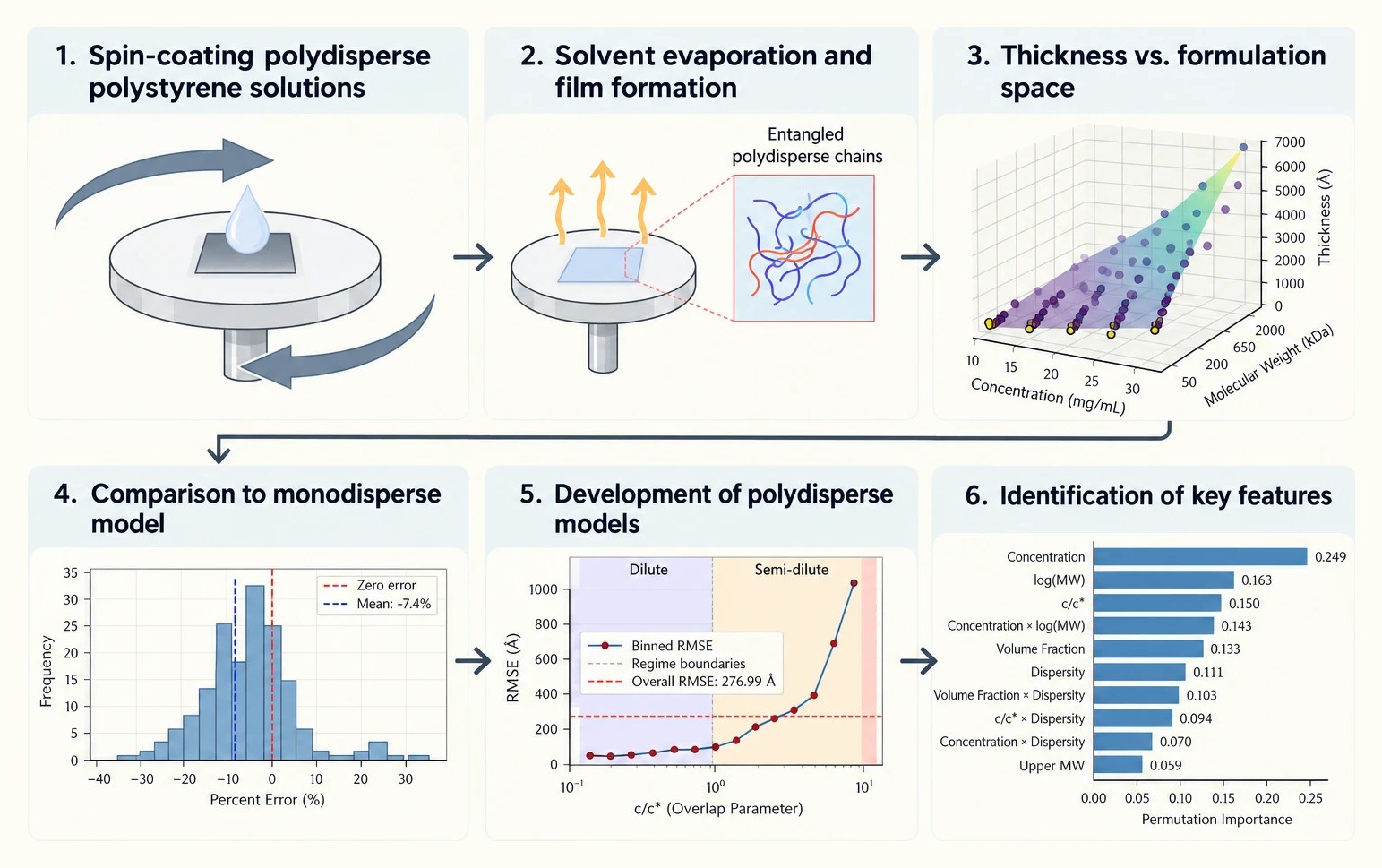
The thickness of spin-coated polystyrene (PS) thin films largely influences their physical properties. While industrial applications primarily utilize polydisperse PS, existing models address only monodisperse systems. We created bidisperse PS films across varying concentrations, molecular weights, and blend ratios, evaluated monodisperse models with bidisperse data, and tested other machine learning models. We discovered that bidisperse films were systematically thinner than monodisperse films of equivalent weight-average molecular weight, with the overlap parameter (c/c*) emerging as a key predictor. Our Gaussian Process Regression achieved MAPE = 3.82% (63% improvement over monodisperse models), R² = 0.9919, and RMSE = 75.2 Å.
Published in MRS CommunicationsRen, B., Krasnoff, E., Bhat, D., Bhattacharya, D., Chan, I., Kiran, A., & Rafailovich, M. (2026). MRS Communications, 16(4), 972–983.
Read the article · Preprint on ChemRxiv (200+ downloads)
Read the article · Preprint on ChemRxiv (200+ downloads)
Conferences and Publications
- Published in MRS Communications (April 2026), following a ChemRxiv preprint (February 2026).
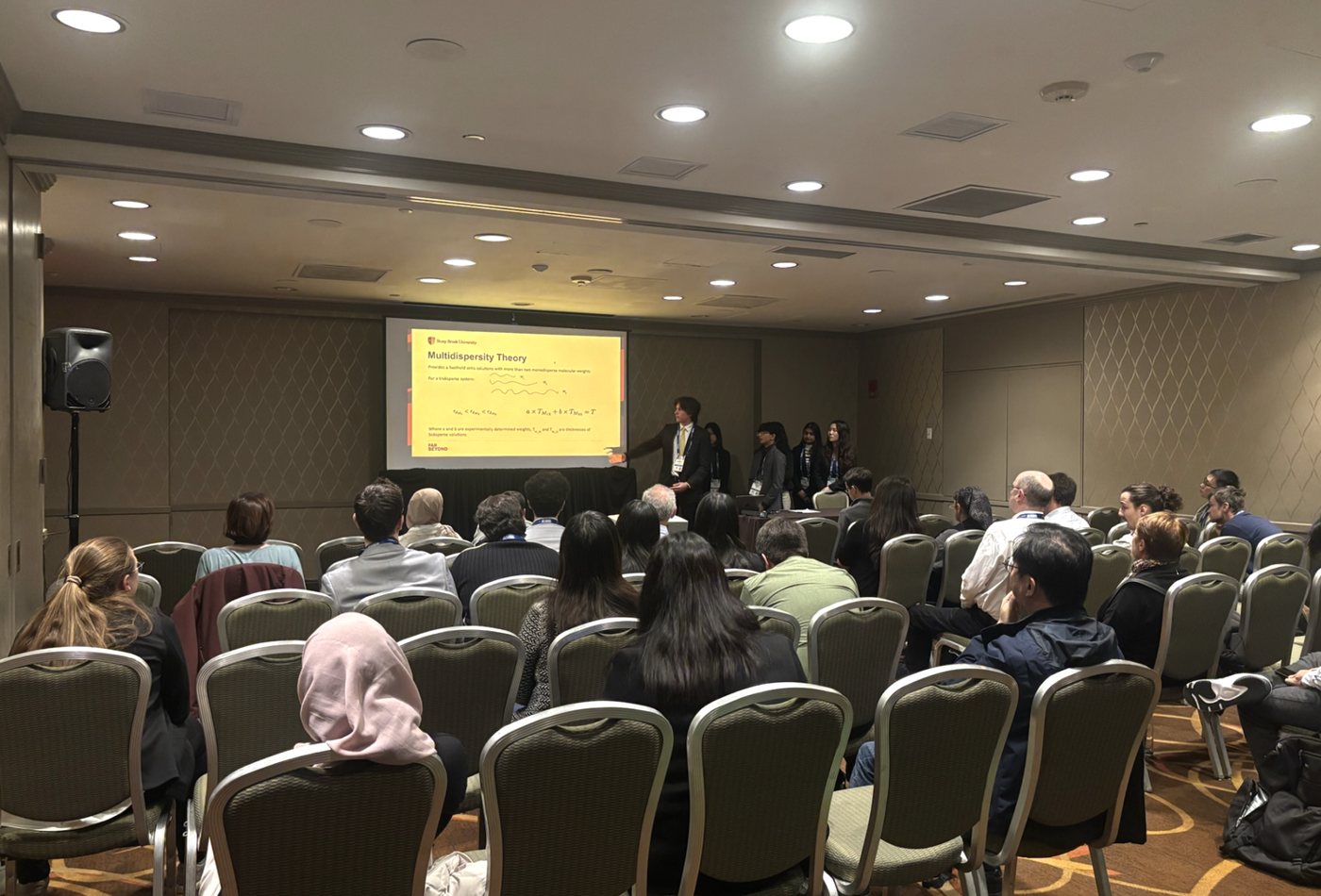
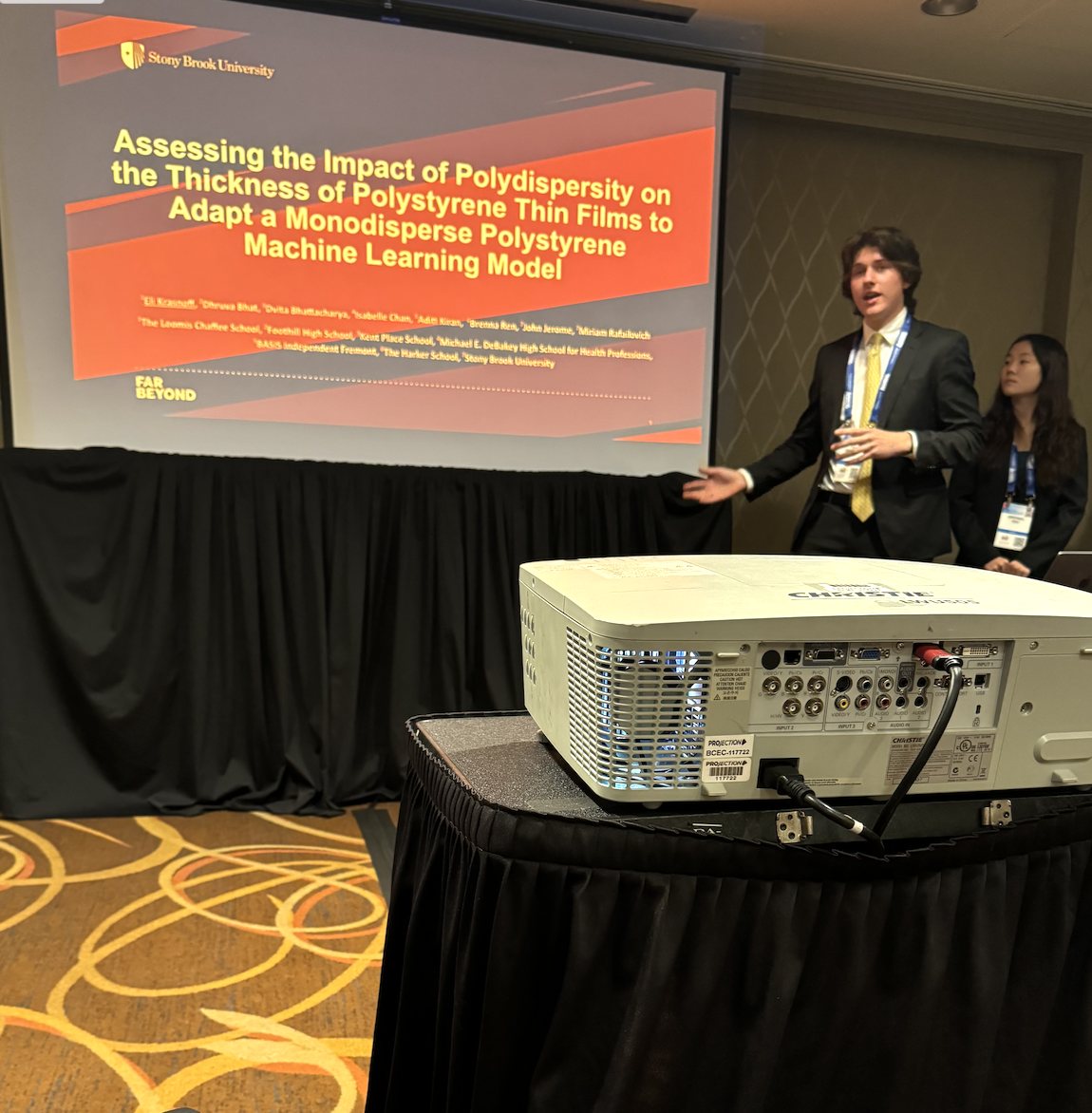
- Oral presentation at the Materials Research Society Fall Meeting (December 2024). MRS abstract
- Oral presentation at the American Physical Society Global Physics Summit (March 2025). APS abstract