Phase 2: Bioengineered Mycelium as a Platform Material for Tissue Engineering
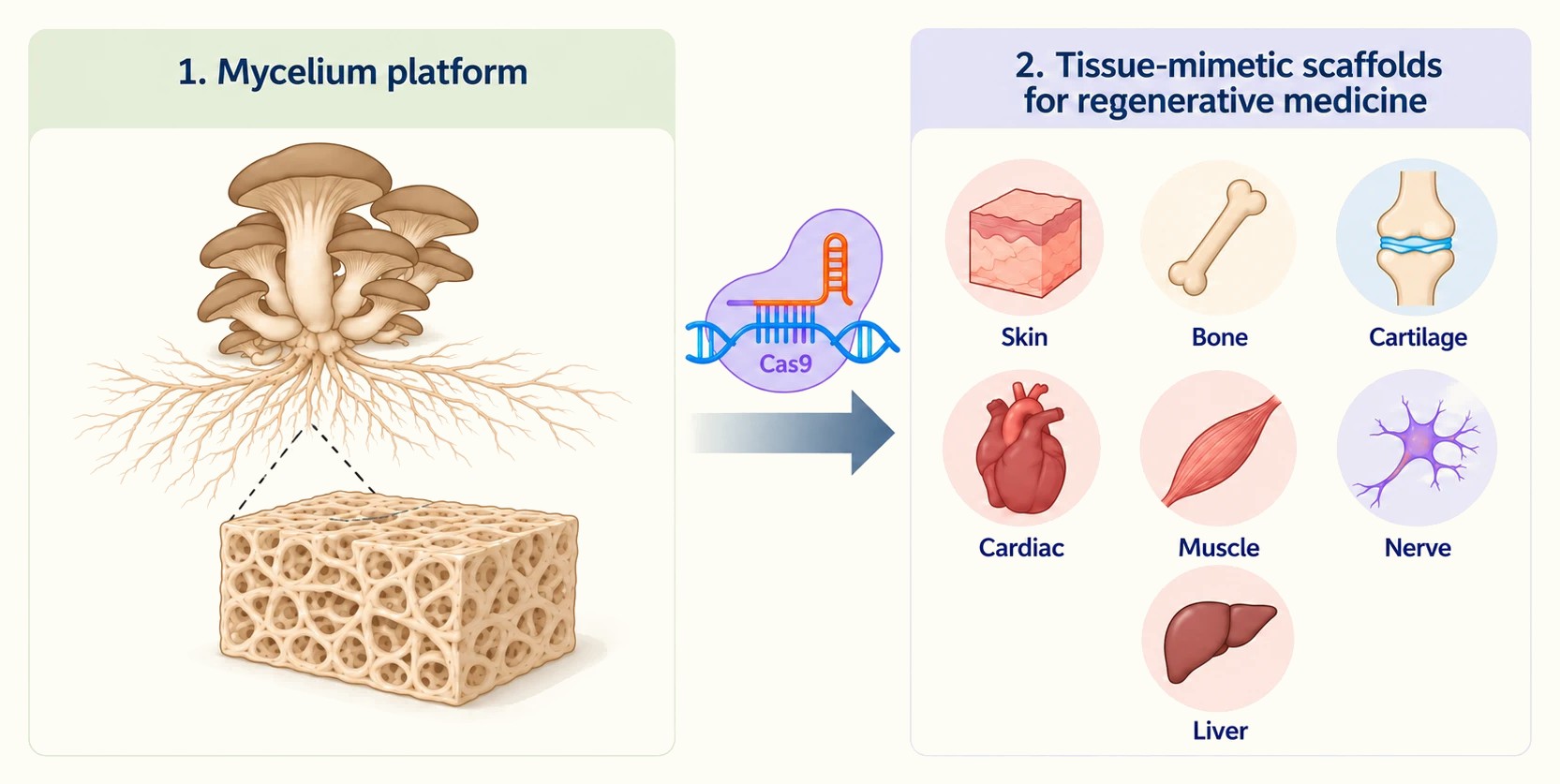
See my first study on mycelium to understand the rationale for using mycelium as a biomaterial for tissue engineering. The project taught me about the necessary properties of an artificial extracellular matrix (ECM), the existing solution space, and characterization methods in tissue engineering, but I didn't achieve my goal of developing a superior platform material for tissue engineering. With the access that Stanford provides its undergraduates to world-renowned mycologists, funding, and lab space, I wanted to take my project to the next level.
Current mycelium bioscaffold optimization relies almost entirely on process-level control like changing the growth medium or environmental conditions, but there is no systematic comparison establishing whether this approach exhausts the attainable design space for regenerative applications. Limited genetic perturbation studies in filamentous fungi demonstrate that single gene edits can induce large, qualitative shifts in density and mechanical behavior, comparable to major processing interventions.
Genetic modification therefore represents an underexplored upstream lever that may enable access to new property regimes, improve uniformity and reproducibility, remove proteins that signal an immune response, and address productization challenges such as manufacturability and geometry independence. Moreover, genetic modification is independent of the desired 3D morphology, whereas downstream processing isn't, likely making genetically modified strains more scalable and versatile.
Research plan
This vision is obviously quite lofty, so I've broken it down into attainable goals:
- Prove that the deletion of a single gene leads to precise and consistent phenotypic changes. Specifically, I hope to show that the deletion of the RolA gene in Aspergillus oryzae—our chosen chassis because of proven biocompatibility and genetic modifiability—leads to increased hydrophilicity and mechanical strength.
- Benchmark this bioengineered scaffold against current literature to prove the viability of this strategy. I will culture the scaffold with skin cells as a direct comparison to literature that uses A. oryzae as a scaffold for skin cell growth.
- Build the genotype-to-property map. Extend from one gene to a panel, measuring cell-wall composition, hyphal morphology, mechanics, uniformity, and immune responses under fixed growth conditions, to map the relationship between edit and property.
- Start exploring other tissue types that mycelium could be used for based on the results of the panel.