Congruent Ventures

I wrote a review on the field of green polymers, highlighting promising future research directions.
Overview of the Green Polymer Market
Overview
There is an increasing need for sustainable production of monomers for polymer synthesis, since the current methods that rely on fossil fuels are harmful to the environment. Thus, the field of green polymers is born. Green polymers, otherwise known as bioplastics, are polymers derived from biomasses, which are more environmentally friendly alternatives to petroleum. The size of the green polymer market is estimated to be $39.46 billion, and it is expected to reach $74.95 billion by 2030, with a CAGR of 9.6%, according to a report by Coherent Market Insights [1]. Their report segments the market by type, application, polymer type, and region. By type, the market is sectioned into biodegradable, biobased, recycled, bio-based non-biodegradable, and partially bio-based. This overview of the market will avoid the category of recycled and partially bio-based polymers, since they are not derived purely from biomasses.
In order to truly create more sustainable processes for monomer synthesis and subsequent polymerization, the processing of the feedstock and the end-life treatment must be considered in addition to the origin of the feedstock for monomer synthesis. For example, while the production of polyethylene from sugarcane juice is technically a bioplastic, the polymerization process to create the polyethylene from sugarcane is identical to the polymerization of fossil-based ethylene. Moreover, even though cellulose is a well-established natural polymer with many applications, the many methods of dissolving cellulose use solvents that are toxic and harmful to the environment. Therefore, when considering the sustainability of bioplastics, it is necessary to also consider the 12 Principles of Green Chemistry throughout the entire lifecycle of the polymer [2].
Green Polymer Market Drivers
The green polymer market is mainly driven by increasing governmental regulations and taxes placed on single-use plastics, as well as the consumer’s increasing environmental awareness. According to a global survey cited in a report by Coherent Market Insights, “75% of consumers prefer buying products in recyclable packaging [1].” Major brands like Nestlé recognize this shift in consumer preference and are shifting their packaging to bioplastics. According to the same report from Coherent MI, “the European Commission has set targets to incorporate 25% of recycled plastic in PET bottles by 2025 and 30% in all plastic packaging by 2030.” Similar to the consumer and governmental shift towards more sustainable polymer production, large corporations are setting sustainability targets to use eco-friendly packaging. For example, PepsiCo aims to use 100% recyclable, compostable, or biodegradable materials for its packaging by 2025. Finally, as technology surrounding bioplastic production advances, they become easier to scale and are much more competitive with conventional petroleum derived plastics.
The State of Bioplastics
In a comprehensive review on the field of polymers based on renewable resources by Gandini et al., it sections the field into three major approaches:
(i) The exploitation of natural polymers to generate novel materials, (ii) the possibility of producing commodity polymers, which are traditionally prepared from fossil resources, using monomers derived from renewable counterparts, and (iii) the use of a variety of monomers and macromonomers derived from renewable resources to prepare original macromolecular structures with unique properties and potential applications in different industrial sectors [3].
This overview will cover the relevant monomers and macromolecules associated with each method and current areas of industrial and/or scientific interest. This overview will also include a separate section for bioplastics synthesized by bacteria, since they make up a large portion of the bioplastics market themselves. Since each monomer/macromolecule has unique upstream processing and polymerization processes, this overview won’t provide an in-depth analysis of the sustainability of each process for brevity.
(i) The exploitation of natural polymers to generate novel materials
The most common natural polymers are polysaccharides, lignin, and natural rubber.
Polysaccharides
Polysaccharides are natural polymeric carbohydrate structures composed of repeating units of monosaccharides (e.g. glucose, fructose, or galactose) or disaccharides (e.g. sucrose or lactose). The most abundant polysaccharides include cellulose, chitin, and starch.
Cellulose: Cellulose is the most abundant natural polymer on earth. It can be directly extracted from vegetable or animal biomass without needing complex upstream or downstream processes, so it is ideal for large scale production. It has a regular linear semicrystalline structure. Cellulose nanofibers and cellulose nanocrystals are commercially available and produced through treatments, such as ball milling, high-pressure homogenization, TEMPO oxidation, acid and enzymatic hydrolysis, and combined techniques.
Starch: Starch is similarly important to cellulose. It is composed of two macromolecular structures with the same glucose monomer units--linear amylose and branched amylopectin. These monomer units allow for a wide array of possible chemical modifications and the production of thermoplastic starch (TPS); although, plasticizers are required to transform semi-crystalline starch granules into a homogeneous continuous material. TPS has been historically limited by its tendency to absorb moisture, which reduces its mechanical properties. Blends are being researched that solve this problem (e.g. with natural montmorillonite, organically modified montmorillonite, cellulose nanocrystals, and cellulose nanofibers). Other well-researched blends include PLA and TPS blends, as well as the association of natural rubber and TPS. Additionally, research is also underway on the influence of the plasticizer type on properties like tensile strength, stiffness, and water vapor and oxygen barrier of TPS and its copolymer blends.
Chitin: Chitin is widely exploited as an abundant animal polysaccharide made up of N-acetyl-D-glucosamine units. The conversion of chitin to chitosan through the base-catalyzed hydrolysis of its amide functions is the most important utilization of chitin in industrial applications. Chitosan has applications in biomedicine, packaging, wastewater treatment, cosmetics, and food science.
Lignin
Lignin has a complex and irregular supramolecular structure. It is abundant in woody plants, and it provides strength, moisture resistance, and protection against microbial attacks. While an estimated 70 Mt of lignin is extracted per year, only about 2% is utilized for chemicals or materials, with the rest burned for energy. Lignin is converted into polymers of interest by fractionation of lignocellulosic biomass (pulping), lignin depolymerization, and then synthesis of desired chemicals. A careful choice of the biomass fractionation process allows for the production of promising aromatic building blocks for polymer synthesis. Increasing interest is being paid to the valorization of lignin over carbohydrates during the pulping process.
Natural Rubber
Natural rubber (NR) is a high molecular weight hydrocarbon polymer. It contains unmatched properties, such as resilience, elasticity, and resistance to abrasion, when compared to synthetic alternatives, leading to global production exceeding 1.3 Mt in 2017. But, its labor-intensive production process poses economic challenges. Scientific interest in NR has focused on enhancing its properties through nanofiber composites, blends, and reversible crosslinking. Efforts to reinforce NR with unmodified natural fibers have been limited, prompting surface modification techniques to improve material performance. Recent research explores NR's potential in advanced applications, including thermally conductive and flame-retardant materials, electronics, and biomedical uses. NR's properties are also beneficial in the pavement industry for enhancing the lifespan and sustainability of flexible pavements. Additionally, NR shows promise in the biomedical field for tissue repair and controlled drug delivery. Further developments in chemical modification and applications of NR are ongoing.
(ii) Producing the exact same monomers from petroleum alternatives
This method looks for alternative feedstocks to synthesize plastics like polyethylene (PE), polypropylene (PP), and polyethylene terephthalate (PET), which are some of the most important polymeric materials for packaging and engineering applications.
The Brazilian Braskem Company is a great proof of concept that bio-based polymers are profitable and have commercial demand. They have produced several hundred thousand tons of PE of different grades, including copolymers, from sugarcane juice since 2012. Once deriving ethylene from sugar cane, they follow identical polymerization steps to that of the fossil-based ethylene. Although, the term “green-PE” or “bio-PE” might mislead consumers, since the resultant PE is not biodegradable and the polymerization process is not environmentally friendly.
The production of PP is also being investigated but still isn’t as cost effective as its petroleum derived counterpart. A report by Machado et al. found that final prices for bio-propylene are 90% higher than those of conventional PP in a Brazilian sugarcane biorefinery [4]. Policies supporting the production of bio-propylene might allow it to be cost competitive. Over time, supportive policies could facilitate enough scale and cost improvements to be competitive on its own.
There has been work done that looks at sourcing terephthalic acid and ethylene glycol, the building blocks of PET, from renewable sources already.
The production of succinic acid, 1,4-diaminobutane, and 1,5-diaminopentane by fermentation of metabolically engineered bacteria was reported by Lee et al., which were used to synthesize fully renewable nylon-4,4 and nylon-5,4 [5].
(iii) Bio-Based Routes for Original Polymers
The exploitation of renewable resources leads to the ability to produce novel structures and architectures previously not easily attainable from the fossil platform. These new macromolecular materials might greatly contribute to the creation of viable biorefineries in the near future.
Vegetable Oils and Glycerol
Vegetable oils are commonly classified as the most important renewable feedstocks. Vegetable oil has been used to develop polyesters, polyurethanes, polyamides, polycarbonates, UV-curable coatings, and more. According to the US Department of Agriculture, almost 90% of all vegetable oil that is produced and distributed around the world come from soybean, palm, rapeseed, and sunflower seeds, with oleic and linoleic acids as their major fatty acids [6].
Research is going into directly polymerizing polyfunctional vegetable oils into thermosets, since the preliminary synthetic steps can be environmentally harmful. However, common fatty acids exhibit slow reactivity, so they often require the use of more reactive comonomers or preliminary modifications like epoxidation. So, recent research focuses on the synthesis of thermosets from epoxidized vegetable oils and their post-use properties, like recyclability and biodegradability.
The development of vitrimers, which are resins with dynamic bond exchange capabilities, has enabled the creation of self-healing and reprocessable materials from vegetable oils. Tung oil, a non-edible oil, has also gained attention for its suitability in polymer synthesis, particularly in smart coatings and UV-curable materials.
The surplus of glycerol from the industrial processing of vegetable oils has spurred research into converting it into high-value products, including glycerol-based polymers, which have applications in cosmetics, food, pharmaceuticals, and biomedical fields. Concurrently, efforts are being put into making the glycerol synthesis process more environmentally sustainable.
Furans
Furans can be formed during the thermal degradation of carbohydrates and are often found as byproducts in heat-processed foods like coffee, bread, and roasted meats. Indicating its increasing popularity, there was an uptick of 350% in search results for keywords “furan” and “polymers” on the Web of Science from 2001-2010 to 2011-2020.
Furan derivatives, such as furfural (F) and 5-hydroxymethylfurfural (HMF), are the precursors of a multitude of monomers that have been successfully synthesized, characterized, and polymerized. Indeed, the search for improved industrial processes to produce HMF is of great interest. Environmentally friendly and energy-saving methods for the conversion of furanic compounds are in full development, as well.
Furfural is commonly used for chain (co)polymerizations, while HMF is utilized in step-growth polymerizations to create polyesters, polyamides, and polyurethanes traditionally made from petrochemicals. 2,5-furan dicarboxylic acid (FDCA) is a HMF derivative, and it is a suitable alternative to terephthalic acid. poly(ethylene 2,5-furandicarboxylate) (PEF) is a derivative of FDCA and is being scaled up for industrial production as a potentially superior replacement for PET. PEF is particularly valued for its superior gas barrier properties.
Recent developments have focused on enhancing furan-based polymers through advanced techniques, such as the Diels–Alder (DA) reaction, which allows for the creation of recyclable, self-healing materials with heat-resistant properties. These materials are being explored for applications in drug delivery, bio-scaffolds, diagnostics, and self-healing biomaterials.
Sugars and Terpenes
The production of polymers from carbohydrate-based monomers is a hot topic of research because of the large variety of sugars readily attainable from edible and non-edible crops, so preparation of the monomers would be low cost.
To produce the desired monomers from a carbohydrate, its monomers (glucose or mannose) can be hydrogenated to produce sorbitol and mannitol. Subsequent double dehydration of sorbitol and mannitol leads to the formation of isosorbide, isoidide, and isomannide. The most research has been put into isosorbide because it is the only one available at reasonable prices from starch, so it is an industrial commodity. The other two isomers are also useful, though, for the design of macromolecular materials, so research is being done to make their production more efficient and scalable.
Additional synthetic sugar-based monomers like xylitol, erythritol, mannitol, and galactitol are chemically modified to produce a variety of polymers, including polyesters, polyethers, polycarbonates, polyamides, and polyurethanes.
Turpentine is derived from the resin of conifers, and it’s composed of monoterpenes, mainly α-pinene and β-pinene. β-pinene is more reactive than α-pinene, but both benefit from being functionalized. These monoterpenes can be used as plasticizers or polymerized to create certain bioplastics.
Other Relevant Bio-Based Monomers
Other monomers like diacids, diols, diamines and other multifunctional molecules like citric acid, levulinic acid, vanillin, and malic acid are used for bioplastic synthesis.
Bacterial Polymers
Bioplastics synthesized by bacteria is a huge field in and of itself, so this overview will only highlight the most interesting applications and advancements.
The most widespread bioplastics synthesized by bacteria are bacterial cellulose (BC), poly(hydroxyalkanoates)s (PHAs), PLA, some starch-based polymers (TPS), and polybutylene succinate (PBS). The most common PHAs include polyhydroxybutyrate (PHB), polyhydroxyvalerate (PHV), polyhydroxyhexanoate (PHH), polyhydroxyoctanoate (PHO), and poly(3-hydroxybutyrate-co-3-hydroxyhexanoate) (PHBH) [7]. PLA, TPS, and PBS consist mostly of biodegradable aliphatic thermoplastic polyesters (thermoplastic meaning that it can be melted and reformed without undergoing significant chemical changes).
PLA is one of the most attractive bio-based polymers, and recent research has been put into the one-step fermentative processes for production of PLA by employing metabolically engineered microorganisms (rather than the microbial fermentation of lactate (LA) and then the chemical polymerization process of LA) [8]. PLA comes from sugars or starch derived from carbohydrates from plants like corn starch, sugar cane, wheat, and rice straws, so its feedstocks are cheap to acquire. PLA is important because it can be processed through a variety of techniques, such as injection molding, blow molding, extrusion over cast film extrusion, and thermoforming.
Polymers from the Syngas Platform
In addition to the use of the renewable platforms outlined above, synthesis gas, also known as syngas, can be used to derive acetic acid, methanol, and ethanol, all three of which are precursors to vital polymers [9].
Acetic acid is most commonly used to produce the vinyl acetate monomer, which accounts for one third of acetic acid’s global usage [10].
More significantly, however, is that acrylic acid has been derived from acetic acid [11]. According to a review by Hayes et al., “acrylic acid and its esters were listed as the 25th top organic chemical product, and the market for acrylic acid grew from $11 billion in 2013 to nearly $19 billion in 2020 [12].” Acetic acid is also a precursor for cellulose acetate, acetic anhydride, acetate esters, and synthetic fibers like acetate and triacetate [13]. Additionally, plasma polymerization of acetic acid produced polylactide-like films on the substrate that improve hydrophilicity and biocompatibility, so it has applications as a coating layer for polymeric substances in biomedical applications [14].
Ethanol can be used to create PE. The same review from above by Hayes et al. outlines the current methods for converting bio-ethanol into bio-ethylene and its subsequent polymerization into PE. According to that review, polyethylene is the most used polymer in the world, and it represents more than 30% of the global plastic market [12]. So, this conversion of ethanol to ethylene is an incredibly impactful process.
Methanol and ethanol can be used to create PP, and the processes are much less streamlined than those for converting ethanol into PE. Lurgi AG--a German-based company operating in the process engineering and plant contracting fields--created a manufacturing facility for propylene from methanol using syngas in 2005 [15],[16]. They managed to yield 471,000 tons/year of propylene for 1.67 million tons/year of methanol produced. Lurgi AG was acquired by Air Liquide, a French multinational company that supplies industrial gases.
Ethanol can also be used to create polybutylene, which is also less developed than the bio-ethylene process. Methanol and acrylic acid can be used to produce alkyl (meth)acrylates.
Opportunities for Bioplastics
The bioplastics industry is expected to grow significantly, with bioplastics potentially capturing a larger share of the overall plastics market than conventional plastics. The following highlights the industries in which bioplastics find the most application.
- The Packaging Industry: Biodegradable bioplastics, such as PBAT, PLA, and PHBV, are used in packaging but often have lower mechanical properties than conventional plastics like PE, PET, or PP. Despite this, some bioplastics display comparable thermal stability and mechanical properties, making them suitable for short shelf-life products. TIPA is addressing the concerns of shelf life for bioplastics used in food packaging.
- Automotive Applications: Automakers are looking to lighter plastics to create more fuel efficient vehicles. PLA, PHA, and natural fiber biocomposites are more sustainable polymers to produce and can reduce the weight of a vehicle by 50%. Toyota Tsusho Americas and Ford Motor Company are conducting R&D in this field, since it is still in the early stages.
- Agricultural Applications: Biodegradable mulch films, made from polymers like PLA and PBAT, are used to enhance soil quality, control moisture, and reduce weed growth. These films also support microbial activity beneficial to plants and are a sustainable alternative to conventional plastics, which are harder to recycle and contribute to plastic pollution.
- Biomedical Applications: Biodegradable polymers are used in drug delivery systems, tissue engineering, and implants. For example, PLA is combined with other materials to improve drug encapsulation and delivery, while PHAs are used in tissue scaffolds due to their biocompatibility and ability to support cell growth.
The review by De Souza et al. curated the following table that highlights the general applications of the main green polymers specifically produced by bacteria [7]:
| Polymer | Applications | Properties | Manufacturers |
|---|---|---|---|
| PLA | Packaging, films, coatings, 3D printing, tissue engineering scaffolds, drug delivery systems, and agricultural films for plague control | High strength and modulus, brittleness, low thermal stability, hydrophobicity, low degradation rate, biocompatibility | Cargill, Galactic, Pyramid bioplastics, Corbion, NatureWorks LLC |
| PBS | Packaging films, hygiene products, bags, coffee capsules, plastic, and wood composites | Similar mechanical properties to PP and PE, high thermal stability, slow degradation rate, high crystallinity | Showa Denko, Mitsubishi, Bio-Amber & Genomatica (Monomers) |
| PHA | Packaging (cosmetics and hygiene products), nanoparticles for drug delivery systems, biocompatible implants, and tissue engineering scaffolds | Fast degradation in several environments, good gas-barrier properties, biocompatibility, low thermal stability | GreenBio Materials, BioMatera, Danimer Scientific, Bio-on |
| Starch Blends | Food packaging, bags, agricultural, textile, and automotive-related products | Low HDT, moisture sensitivity, brittleness | Biobag, Avebe, BIOTEC, CPR Corp., Cere-plast, Huhtamaki, EarthShell |
According to a review by Ibrahim et al., the production of bioplastics from bacteria is only expected to increase [17].
Caution of Biodegradability
The origin of a polymer does not necessarily translate into its ability to biodegrade or not. Rather, a polymer's ability to biodegrade is largely dependent on the specific molecular structure of polymers, the additives used in the polymerization process, and the microstructural characteristics. Other important parameters include: weight loss (its degradation into smaller fragments over time), changes in thermal properties as it degrades, changes in mechanical properties, and its mineralization rate (how quickly the polymer is converted into basic inorganic substances by microorganisms).
Also, the degradation of a polymer may depend on its environment. PHAs biodegrade in most aerobic and anaerobic environments by American Society for Testing and Material (ASTM) standards, but PLA is resistant to degradation specifically in aquatic media. These differences in biodegradation are due to the differences in the mechanisms of degradation for each polymer.
Moreover, bio-PE, bio-PP, and bio-PET are not biodegradable even though they are produced from renewable sources [7].
This figure from the review by de Souza et al. outlines the split of bioplastics that are biodegradable vs. not biodegradable [7].
Green Polymer Market Trends
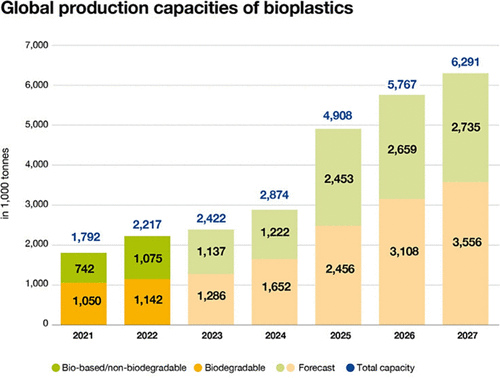
- Growing Adoption of Biodegradable Bioplastics: Biodegradable plastics are becoming increasingly necessary in industries like packaging, agriculture, textiles, etc. as legislation imposes restrictions and taxes on single-use plastics (e.g. single-use plastic bans have been imposed in 60+ countries). Biodegradable bioplastics like PLA, PHA, PBS, and starch blends are becoming increasingly popular across these industries because of their biodegradability. So, key players in the bioplastics industry are increasing their production capacity to keep up with the increasing demand for biodegradable bioplastics.
- Rising Demand for Eco-Friendly Textiles: Big names in the textile industry are looking to bioplastics as alternatives to polyester. For example, 60% of H&M’s fabrics are now made from recycled or biosourced content like recycled PET and lyocell.
- Increasing Use of Bioplastics in 3D Printing: PLA and PVA are used for 3D printing filaments. The adoption of additive manufacturing across industries has led to the increase of popularity of PLA and flexible TPU filament.
- Focus on Enhancing Properties and Performance: There is an intense research focus on improving the bioplastics’ mechanical properties (like heat resistance, strength, and barrier).
- Scaling and Optimizing Bacterial Bioplastics Production: While bioplastics from bacteria offer a favorable alternative to conventional plastics, they suffer the problem of scaling and cost. So, optimizing their production to minimize costs, allowing for more variable conditions for effective fermentation, and creating a more streamlined purification process are major research focuses.
- Emerging Markets Favorable Policies: Emerging economies like China, Brazil, and India are implementing policies and incentives to promote bioplastics manufacturing to reduce reliance on imported petrochemicals and tackle plastic pollution issues.
Major players
According to the same report from Coherent MI, the major players in the Green Polymer Market include BASF, Dow Chemical, Braskem, NatureWorks, Novamont, Biome Technologies, Indorama Ventures, Metabolix, Bio-On, Plantic Technologies, Danimer Scientific, Toray Industries, Teijin, Unitika, Toyobo, Mitsubishi Chemicals, Purac, Sulzer Chemtech, Myriant Corporation, and BioAmber.
Works Cited
- Coherent MI. "Green Polymer Market Size And Share Analysis - Growth Trends And Forecasts (2023 - 2030)." Coherent MI, www.coherentmi.com/industry-reports/green-polymer-market.
- Anastas, Paul, and John Warner. "12 Principles of Green Chemistry." ACS, www.acs.org/greenchemistry/principles/12-principles-of-green-chemistry.html.
- Gandini, Alessandro, and Talita M. Lacerda. "Monomers and Macromolecular Materials from Renewable Resources: State of the Art and Perspectives." Molecules, vol. 27, no. 1, 28 Dec. 2021, p. 159. National Library of Medicine, https://doi.org/10.3390/molecules27010159.
- Machado, Pedro Gerber, et al. "Bio-based propylene production in a sugarcane biorefinery: A techno-economic evaluation for Brazilian conditions." Sci Journals, scijournals.onlinelibrary.wiley.com/doi/10.1002/bbb.1674.
- Lee, Jong An, et al. "Synthesis, Characterization, and Application of Fully Biobased and Biodegradable Nylon-4,4 and -5,4." ACS Publications, pubs.acs.org/doi/10.1021/acssuschemeng.0c00007.
- Economic Research Service. "Oil Crops Sector at a Glance." USDA, www.ers.usda.gov/topics/crops/soybeans-and-oil-crops/oil-crops-sector-at-a-glance/.
- De Souza, Felipe Martins, and Ram K. Gupta. "Bacteria for Bioplastics: Progress, Applications, and Challenges." ACS Publications, pubs.acs.org/doi/10.1021/acsomega.3c07372#:~:text=PHAs%20are%20among%20the%20most,or%20acceptors%2C%20among%20other%20factors.
- Choi, So Young, et al. "Biocatalytic synthesis of polylactate and its copolymers by engineered microorganisms." National Library of Medicine, pubmed.ncbi.nlm.nih.gov/31630738/.
- Global Syngas Technologies Council. "Syngas Applications." GSTC, globalsyngas.org/syngas-technology/syngas-applications/chemicals/methanol/.
- Murillo, Homar. "What Are The Common Uses Of Acetic Acid?" Chemicals, www.chemicals.co.uk/blog/what-are-common-uses-of-acetic-acid.
- Avasthi, Kalpana, et al. "Advances in catalytic production processes of biomass-derived vinyl monomers." Royal Society of Chemistry, pubs.rsc.org/en/content/articlelanding/2020/cy/d0cy00598c.
- Hayes, Graham, et al. "Polymers without Petrochemicals: Sustainable Routes to Conventional Monomers." National Library of Medicine, www.ncbi.nlm.nih.gov/pmc/articles/PMC9999446/.
- Murillo, Homar. "What Are The Common Uses Of Acetic Acid?" Chemicals, www.chemicals.co.uk/blog/what-are-common-uses-of-acetic-acid.
- Liao, Shu-Chuan, et al. "Acetic-Acid Plasma-Polymerization on Polymeric Substrates for Biomedical Application." Nanomaterials, vol. 9, no. 7, 28 June 2019, p. 941, https://doi.org/10.3390/nano9070941.
- Noronha, Fabio Bellot, et al. Natural Gas Conversion VIII : Proceedings of the 8th Natural Gas Conversion Symposium, May 27-31, 2007, Natal, Brazil. Amsterdam, Elsevier Science, 2014.
- CHEManager. "Lurgi GmbH." CHEManager, www.chemanager-online.com/en/companies/lurgi-gmbh-0.
- Ibrahim, Nor Izaida, et al. "Overview of Bioplastic Introduction and Its Applications in Product Packaging." MDPI, www.mdpi.com/2079-6412/11/11/1423.
Primary sources for each section
Suggested Further Readings
Bacteria for Bioplastics: Progress, Applications, and Challenges
Green Polymer Market Size and Share Analysis- Growth Trends and Forecasts (2023 - 2030)
Monomers and Macromolecular Materials from Renewable Resources: State of the Art and Perspectives
Overview of Bioplastic Introduction and Its Applications in Product Packaging
Polymers from Renewable Resources: A Challenge for the Future of Macromolecular Materials
Polymers without Petrochemicals: Sustainable Routes to Conventional Monomers